
 English


| PDF Export | |


According to different requirements, the floating head on a floating head heat exchanger can be designed into various types, in addition to consider that the tube bundle can move freely within the device, we must also take into the convenience of maintenance, installation, and cleaning for the heat exchanger.
Generally, there are four basic types of floating head heat exchanger – outside packed stuffing box (TEMA P), outside packed lantern ring (TEMA W), the floating head with backing device (TEMA S), and pull through (TEMA T) designs.
SINOHEX can manufacturer various kinds of floating head heat exchangers accordance with the TEMA, API660, and JISB8249. Other special requirements are also available.
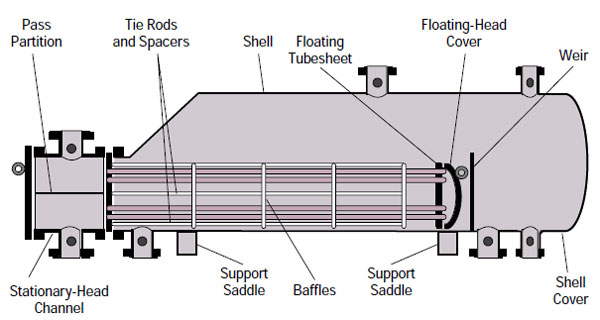
Pull Through Floating Head Heat Exchanger (TEMA T)
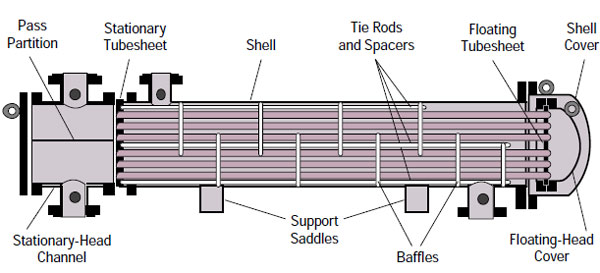
Pull Through Floating Head Heat Exchanger (TEMA S)
Working principle
The operating principle of this type of heat exchanger is simple. When the allowable pressure drop on the tube side is significantly low and no liquid can be introduced into the shell side, a floating head heat exchanger is recommended. The allowable tube-side pressure drop becomes the limiting factor in determining the length and number of tubes, and the shell-side pressure drop is maximized within that size by a baffle arrangement that provides the necessary performance.
Types
The floating head on a floating heat exchanger can be of different types depending on requirements. To reduce thermal stresses and provide a way to remove the tube bundle for cleaning, different floating heads have been designed. Below are four basic types..
Split Back Ring (Type S)
A Split Back Ring type unit is most commonly used in industry. In this type of construction, the floating head is mounted on the tube sheet removed from the channel. The floating head is held in place by a split support ring, allowing disassembly. The diameter of the floating tube sheet is kept slightly smaller than the diameter of the inner shell so that the entire tube bundle can be removed from the channel end.
Pull-through bundlee (Type T)
In the pull-through bundle type, one of the tube sheets is designed so small that it can be pulled through the shell. This provides access to the inside of the shell so that it can be inspected, repaired and cleaned. However, this design has fewer tubes than the others, resulting in slower heat transfer. There are fewer tubes for the cover flange and bolt circle.
Outside packaged lantern ring (Type W)
In this type, the flows on the shell side and the tube side are separately sealed by individual gaskets and separated by a lantern ring. This is the least expensive of the floating heads. This type is recommended for low pressure, low temperature and non-hazardous fluids.
Outside packed stuffing box (Type P)
In this type, a skirt attached to the float tube sheet runs through the rear end of the cap. The space between the skirt and the shell is sealed by several layers of gasket and packing gland. Unlike the external lantern ring design, it contains four tubes instead of two, transferring heat from medium to medium faster. It is recommended for non-hazardous fluids under low pressure and low temperature.
Heat Exchanger TEMA type AES with Floating Head
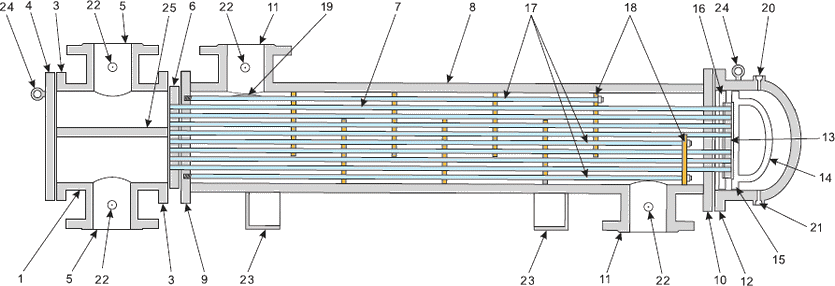
| 1. Stationary Head-Channel | 2. Stationary Head-Bonnet | 3. Stationary Head Flange Channel or Bonnet | 4. Channel Cover | 5. Stationary Head Nozzle |
| 6. Stationary Tubesheet | 7. Tubes | 8. Shell | 9. Shell Flange Stationary Head End | 10. Shell Flange Rear Head End |
| 11. Shell Nozzle | 12. Shell Cover Flange | 13. Floating Tubesheet | 14. Floating Head Cover | 15. Floating Head Cover Flange |
| 16. Floating Head Backing Device | 17. Tierods and Spacers | 18. Transverse Baffles or Support Plates | 19. Impingement Plate | 20. Vent Connection |
| 21. Drain Connection | 22. Instrument Connection | 23. Support Saddle | 24. Lifting Lug | 25. Pass Partition |


